Editor's Choice
Batwara 1947 Fails to Find Its Footing in Heart of Audience

Batwara 1947 Fails to Find Its Footing in Heart of Audience
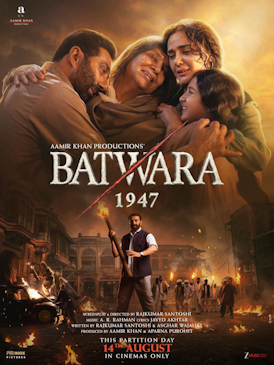
Despite an impressive ensemble and a legendary director at the helm, Batwara 1947 appears to be losing steam with audiences, struggling to maintain momentum in its theatrical run.
At the heart of the film’s challenges lies a fundamental storytelling problem. Sources suggest the narrative — drawn from inspiration by the celebrated stage play Jis Lahore Nai Vekhya, O Jamya E Nai — leans heavily into a slow-burn theatrical rhythm that simply doesn’t translate with enough urgency for a mainstream cinematic audience. Entertainment circles note that director Raj Kumar Santoshi’s deep loyalty to the source material may have come at the cost of broader commercial appeal.
Sunny Deol emerges as the film’s saving grace, with critics noting that several sequences are elevated almost entirely by his commanding screen presence and committed performance. Veteran actress Shabana Azmi delivers with characteristic polish, as expected from one of Indian cinema’s most accomplished performers.
However, not every performance lands as intended. Insiders point out that Abhimanyu Singh, despite bringing a menacing energy to his antagonist role, struggles to convincingly carry the regional linguistic authenticity required for the part — a noticeable gap that chips away at the film’s immersive quality.
Perhaps most surprisingly, the musical score — from one of the industry’s most celebrated composers — has drawn criticism rather than praise. Sources reveal that the soundtrack fails to serve the film in a meaningful way, representing a rare misfire for the acclaimed musician.
Ultimately, entertainment circles suggest that Batwara 1947 carries the weight of talented individuals working within a framework that was never quite built for the big screen. A rating of 2 out of 5 reflects a production that, despite its sincerity, leaves audiences feeling the absence of a compelling cinematic story to rally behind.
The real tragedy, critics note, is the wasted potential of a cast that deserved a sharper, more audience-conscious vehicle.
- Entertainment Desk, Studio Carry On Harry
Harry Johal’s Take
The Santoshi question cuts to something real: Ghayal and Damini worked precisely because his sincerity collided with stories that had cinematic urgency already baked in. Batwara 1947 feels like a case where the industry mistook a director’s reverence for source material as a greenlight — when what the project actually needed was someone to ask whether Jis Lahore Nai Vekhya could survive the translation from intimate stage language to two-and-a-half hours of theatrical exhibition. The miscalculation isn’t Santoshi’s alone; it’s a production-level failure to stress-test the material before the c
Editor’s Verdict
Stage-to-screen adaptations have a long, complicated history in Indian cinema, and *Batwara 1947* appears to be the latest casualty of that particular challenge. Raj Kumar Santoshi’s reverence for the source material is understandable — *Jis Lahore Nai Vekhya* is genuinely celebrated theatre — but reverence alone rarely fills seats. What works on a stage, where the audience leans into stillness and language, demands a fundamentally different grammar when projected on a 70-foot screen. A slow-burn rhythm requires exceptional structural confidence to sustain mainstream cinema audiences, and somewhere between adaptation and execution, that confidence seemingly never arrived. When even the musical score — typically a safety net for struggling Indian films — becomes a liability, the production’s foundational problems become impossible to paper over. Beyond the headlines, the real question this film quietly raises is whether Bollywood has yet developed the craft vocabulary to honour literary and theatrical source material without either suffocating it or losing its audience entirely.
Studio Ki Raye
Raj Kumar Santoshi ka naam sun ke audience expect karti hai *Damini*, *Andaz Apna Apna* — woh punch, woh pacing. Lekin yahan jo hua woh Bollywood ka ek classic trap hai: ek acclaimed stage property ko uski theatrical soul ke saath hi screen par le aao, bina yeh samjhe ki multiplexes mein baithe audience ke paas woh patience nahi jo theatre hall mein hoti hai. Sunny Deol ka performance shayad DVD ya OTT par zyada appreciate hoga — kyunki tab audience apni terms par engage kar sakti hai. Asli sawaal yeh hai ki itne bade ensemble ko greenlight karte waqt kisi ne screenplay ko cinematic lens se kyun nahi dekha? Sincere films aati hain, jaati hain — aur yahi in ka tragedy hota hai.
Enjoyed this story? Follow Studio CarryOnHarry at carryonharry.com · Sources cross-checked via livenewsvault.com · 👍 Facebook · X · 📢 Share this story
—