
Books
Mahayogi-Highway 1 to Happiness, Review: An impassioned monologue for universal peace and tolerance


[ad_1]

Mahayogi-Highway 1 to Happiness, Review: An impassioned monologue for universal peace and tolerance
There are films and there are films. Some are routine, masala, formulaic films, and there are path-breaking, experimental films, off the beaten track. There are also films that can barely be called films. These are genre-defying (which is the experimental part) and grammar-denying (which is the indulgent part). Mahayogi-Highway 1 to Heaven (English) is one such film. 90% of the film is a one-man-show, with that man’s own voice over, whether on screen without any living things or when he is speaking for himself, as a commentary.
Non Resident Indian (NRI) Rajan Luthra has made one such film, which has the thinnest thread of linear narrative and the one of the longest discourses on burning issues, like war, religious intolerance and oneness of the world. Seems a noble film on paper. But when you watch it, you cannot shy away from the bare fact that this is not cinema as we know it. There is a semblance of a beginning, middle and end, in the right order, but nothing really happens in the film.
We hear tomes upon tomes of lectures and prayers about all that is wrong this world, wrongs perpetrated by politicians and religious players, and we hear messages that tell us to look inwards in our quest for seeking contact with our maker, and with world peace and tolerance. This is what every holy-man does as a daily routine, but our protagonist is not-our regular God-man. He is a businessman-turned philanthropist, who shares his spiritual search with the audience. But it is constructed in the commentary-added-to-chosen-visuals style, or vice versa, with the monologue/discourse much more prominent than the sparse dialogue and story. Certainly not everyman’s cup-of-tea.
I cannot help remembering an incident when Raju Nair, an acquaintance, referred me to producer-director Mahesh Bhatt, to get me an acting assignment, four decades ago, and asked me to meet him at a sound recording studio-cum-laboratory in Tardeo, Central Mumbai. I arrived at the appointed time, and was told to remove my shoes and then enter the hall. On entering, at the appointed time, I saw Mahesh Bhatt, Raju Nair and about 10 other men, seated on the floor, leaning their backs of the wall, and a pin-drop silence. I thought some tragedy had struck. But a sound dispelled all such doubts. It was emanating from a two-in-one cassette player, and obviously sounded like the voice of Acharya (also later called Bhagwan and Osho) Rajneesh, the worldly-wise sadhu who had his base in Pune. Noticing that I had entered the room, Raju Nair gestured to me to sit down like all others, and listen to that audio-tape. Not listening was not an option, because I was the seeker and Mahesh Bhatt the giver.
It went on for about 45 minutes, one whole side of a cassette. Cassettes, the most common form of recordings, those days were manufactured in two standard lengths, 30 minutes a side and 90 minutes a side. This was the latter variety, and, apparently, begun a minute or so before I entered. Nobody was saying anything. All were glued, in a trance-like posture. I sat down too, perplexed, but not before I had spotted Raju and said to him, “Raju, I…,” when I was politely silenced with a shush from both Raju and Bhatt. In this recording, Rajneesh was discussing some of the more spiritual poems of Mirza Asadullah Khan ‘Ghalib’, an Urdu and Persian(Faarsee) poet who lived in the 19th century, when the British rule over India was at its peak, and the weak Indian Emperor BahadurShah ‘Zafar’s empire was crumbling. Zafar was a great patron of the arts, specially poetry, and there were a highly skilled lot of poets in his durbar. ‘Daagh’ Dehlvi was his ustaad (teacher) and the poets who adorned his poetical soirees included Momin Khan Momin and Mirza ‘Ghalib’. Many felt that ‘Ghalib’ was the best of the lot. ‘Ghalib’ paid obeisance to his predecessor of a generation ago, Meer Taqee ‘Meer’ and held Momim in great esteem. There few others who could match his calibre. ‘Ghalib’ had declared that his Urdu poetry was no match for his own Persian poetry. Besides being a poet, ‘Ghalib’ was philosopher par excellence, and his philosophy often echoed in his poetry.
Rajneesh was a wayward student in Madhya Pradesh, who dabbled in lecturing for a while before taking up the saffron robes and settling down in Pune, in a place called Koregaon. He had a cult following of millions, Indians, NRIs and members of the Christian faith, from Europe and America. They made him a billionaire. When his philosophy, which included free sex, snow-balled into a huge controversy, and he feared attacks or arrest, he moved from Koreagaon to Oregon, USA. While practicing his form of yoga, he attracted many high profile personalities from business and films.
Among his followers in film-land, Mumbai, were Vinod Khanna, Vijay Anand and Mahesh Bhatt. I had never met Vinod Khanna, but Mahesh was a fellow student at National college, Bandra, my senior, who was having an affair with a Christian girl, who lived in a Christian hostel near my house. He would anxiously wait for her at a bus stop. We would often meet and talk for a while, before he met his girl, and I headed home. He met me a few years later at a recording studio, where I was writing the radio advertisements for the film Mera Gaon Mera Desh, and he was associated with its director, Raj Khosla. After college, when he had directed 2-3 films, I met him a couple of times at the HMV studios and asked him for a role. He had arrogantly dismissed me and said that I should come to his office to seek audience on such matters. It appeared that he could not recall any of his earlier meetings with me, or chose to forget me altogether.
Having made the acquaintance of Raju Nair, who was the Chief Assistant to Muti-ur-Rehman Naushad, son of the venerated music director, in whose film My Friend, I had a cameo appearance, I thought asking for a reference to Mahesh Bhatt might work. It had ‘worked’ so far. But when the tape stopped, at the end of Side way, Mahesh promptly turned it to the other side, Side B, and another 45 minutes would follow. This was too much for me to bear, and I sneaked out, in spite of Raju’s signals to me to continue to remain seated and listening to the programme. Watching Rajan’s film Mahayogi, I was reminded of this incident. Although Rajan is a seeker in the film, and not the routine yogi, who has hundreds or hundreds of thousand followers, he was a loner. I have no knowledge about his association with the Rajneesh Ashram, either her or in the USA, but the monologue seems to be tribute to Rajneesh, though he talks in a matter-of-fact way and wears no robes, but has long hair. His discourse, too, is rather worldly, but if you asked me if it was inspired by the Lao-Tsu, the ancient Chinese philosopher, whom Rajneesh held in high esteem, I would not comment, not having read Lao-Tsu’s works and words. Also known as Laozi legendary ancient Chinese philosopher and author of the Tao Te Ching (Laozi), the foundational text of Taoism along with the Zhuangzi. A Chinese honorific typically translated as “the Old Master (zi)”. A central figure in Chinese culture, Laozi is generally considered the founder of Taoism.
After a long period of search and prayers, Raj (as he, Rajan, is called in the film) attains some kind of sainthood. Meanwhile he winds-up his roaring, highly profitable business, which got him an apartment facing HOLLYWOOD, and embarks on a journey that brings him back to India (Swadesh, by Ashustosh Gowarikar comes to mind instantaneously), where he visits a host of holy places, of many religions, in search of divine guidance, till nature (named Sakshi in the film) and God (Lord Shiva) start talking to him. Mahayogi gives the message of stopping war and talks about mutual love, affection and peace.
Mahayogi, produced under the banner of Triloc Films Inc., USA, presents a touching story. The whole world should live in love and peace and should people and nations should not fight. There should never be a war between any two countries, he preaches. The movie has been described by its makers as a film in which “…God’s heart is crying, seeing people fighting among themselves in the name of politics and religion. Casteism and racial discrimination has increased today. Neighboring countries are bent on war and people are not ready to live together with their neighbors. There is unrest, bombs, missiles and death everywhere. In such circumstances, a volcano of anger is erupting from inside the earth.
In such a situation, Mahayogi has come to tell all of us that this will not happen again. Now the time has come for humanity to wake up. Kalyug is about to end and soon Satyug will begin. The film gives the message that we should forget religious, social and internal discrimination and walk on the path of mutual love, peace and global unity. Only then will the good times begin.

Producer director Rajan Luthra is conveying the message of God to people through his film Mahayogi Highway 1 to Oneness that God resides in mutual love, harmony and unity.”
In the film, glimpses of American cities San Francisco and Los Angeles look attractive, while the beautiful locations of Haridwar and Kedarnath are also evocative. There is not much else, though, in this 104 minutes’ film. Rajan Luthra, the producer-director and principal actor is everywhere. All the American actors are either seen on laptops or in mid-close-up cameos. Needless to say, they all convert to Raj’s philosophy during the course of the film. There is nothing to attract entertainment seekers, and the announcement of ‘To be continued’ appears pompous, with the fate of the first outing likely to nosedive on release.
It is a pity that such noble sentiments have been served by an amateur film-maker, in documentary-voice-over style. Many motifs are repeated. The photography and editing leave much to be desired. Surely, this is not the Highway 1 to Happiness. It is agonisingly slow and intolerably preachy. Nobody will question the makers’ intentions, but should he not have released an audio book instead of making a film?
I am avoiding rating this film, on account of the fact that it is not a regular film, and comparisons with other films, even films close to this genre, would be odious and doing injustice to this indulgent enterprise.
[ad_2]
Press Update For Studio CarryOnHarry
Find Holiday Deals Flights Attractions and Hotels !
Get Interviewed

Save on Travel with Trip.com (ENG)
For Interviews At Studio CarryOnHarry Online Submission Form Click Here
Related Posts

Scottsdale Author Joe Reina’s New Novel Follows a Killer Who Gets Away With It
Balle Balle Radio™ Entertainment Desk Joe Reina has published a new novel, "Shadows over Scottsdale: An Unsolved Murder Mystery," built…
Joe Reina’s ‘Lost Masterpieces’ Imagines a Fictional Farewell Among Renaissance Painters
Balle Balle Radio™ Entertainment Desk Joe Reina has published a new novel, "Lost Masterpieces: Three Paintings, 500 Years A Journey…

Katt Taylor’s New Novel Follows a Woman’s Fractured Spirit from Darkness to Awakening
Balle Balle Radio™ Entertainment Desk Katt Taylor has released "The Mental Woman Within," a novel tracing the spiritual unraveling and…

New Children’s Book ‘Mocha, the Ground Fairy’ Follows a Guinea Pig Determined to Fly
Balle Balle Radio™ Entertainment Desk Dr. Leslie Merida-Gonzalez has published a new children's book, "Mocha, the Ground Fairy," through Fulton…

Fulton Books Author Abagail Lynn Releases Fantasy Adventure “The Rebel”
Balle Balle Radio™ Entertainment Desk Abagail Lynn has released a new novel, "The Rebel," a fantasy adventure centered on an…

Retired Sacramento Pulmonologist Pitches Self-Monitoring Alternative to Health-Care Bureaucracy in New Book
Balle Balle Radio™ Entertainment Desk Del Meyer, a Sacramento-based pulmonologist, has authored a book contending that the central challenge in…

Balle Balle Radio™ Entertainment Desk
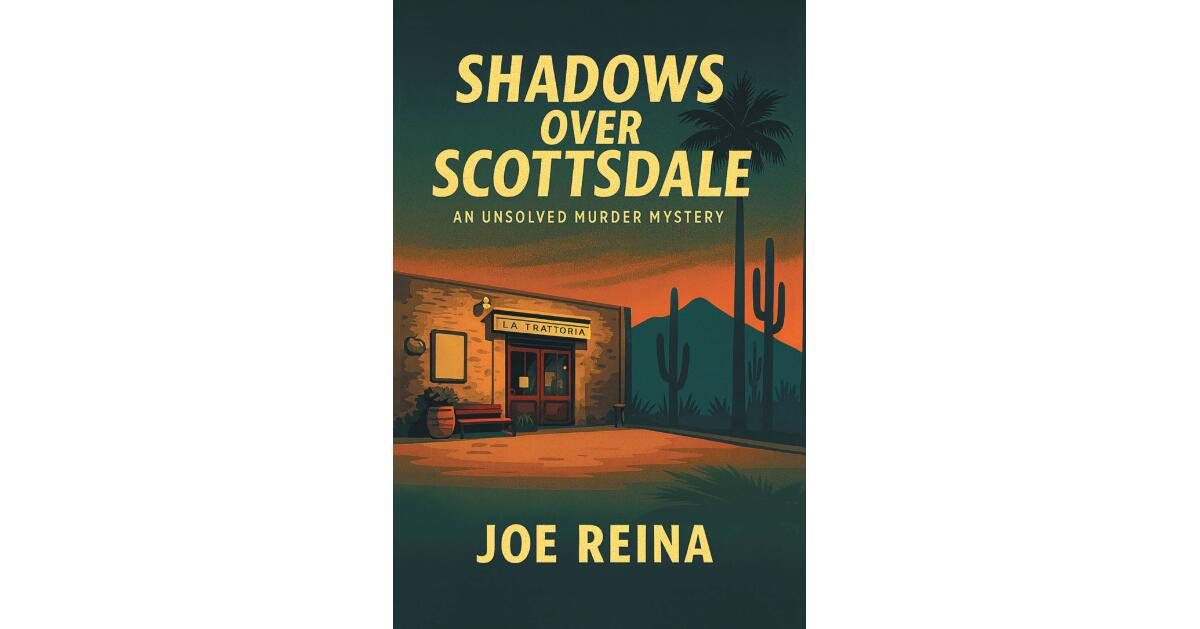
Joe Reina has published a new novel, "Shadows over Scottsdale: An Unsolved Murder Mystery," built around a scenario true-crime statistics make uncomfortably familiar: a man commits a devastating crime and simply disappears, leaving investigators and a grieving community with no resolution.
The book follows a character named Robert, who flees the country using forged documents and a cargo ship after an act of destruction that leaves behind, as the publisher describes it, charred remains and an unanswered investigation. The case goes cold. The novel, according to its publisher, is less concerned with the mechanics of the escape than with what happens afterward, to the people left waiting for answers that never come.
Reina, now retired in Scottsdale, spent decades in international business across apparel, footwear, and real estate, with extensive time in Europe and a particular connection to Italy that shaped two earlier books, "The Goat Sleeps in the Kitchen" and "A Love Affair in Tuscany." "Shadows over Scottsdale" marks a different direction, built instead around the real scale of unsolved homicide in the U.S. The publisher’s materials cite roughly 346,000 unsolved homicides since 1965, with more than a dozen occurring unresolved each day. Separate reporting on the book has cited a figure of about 7,778 murders in 2023 alone, which it similarly frames as more than a dozen a day going unresolved.
"Writing ‘Shadows over Scottsdale’ forced me to confront uncomfortable questions about justice itself," Reina said, according to the announcement. "Too many crimes go unsolved, too many families wait endlessly for answers. I wanted readers to understand that behind every cold case statistic is a real story, real suffering, and real questions that may never be answered."
The publisher positions the novel as an examination of institutional limits as much as a crime story: the toll of a case gone cold on the people who can’t move past it, and what it means for a community when accountability simply never arrives.
"Shadows over Scottsdale" is published by Covenant Books and is available in paperback and hardcover through the publisher’s website and major retailers including Amazon, Barnes & Noble, and Apple Books.
Cold-case statistics tend to get cited and then forgotten. Studio CarryOnHarry is curious whether fiction built directly around that number does more to stick with a reader than the number alone ever does.
Read more People’s Choice stories on Studio CarryOnHarry. Reporting via Live News Vault.
Are you an author with a new release? We’re always looking for books to cover and authors to interview — tell us about yours here.
Press Releases at Studio CarryOnHarry
Related Posts
Joe Reina’s ‘Lost Masterpieces’ Imagines a Fictional Farewell Among Renaissance Painters
Balle Balle Radio™ Entertainment Desk Joe Reina has published a new novel, "Lost Masterpieces: Three Paintings, 500 Years A Journey…
Katt Taylor’s New Novel Follows a Woman’s Fractured Spirit from Darkness to Awakening
Balle Balle Radio™ Entertainment Desk Katt Taylor has released "The Mental Woman Within," a novel tracing the spiritual unraveling and…
New Children’s Book ‘Mocha, the Ground Fairy’ Follows a Guinea Pig Determined to Fly
Balle Balle Radio™ Entertainment Desk Dr. Leslie Merida-Gonzalez has published a new children's book, "Mocha, the Ground Fairy," through Fulton…
Fulton Books Author Abagail Lynn Releases Fantasy Adventure “The Rebel”
Balle Balle Radio™ Entertainment Desk Abagail Lynn has released a new novel, "The Rebel," a fantasy adventure centered on an…
Retired Sacramento Pulmonologist Pitches Self-Monitoring Alternative to Health-Care Bureaucracy in New Book
Balle Balle Radio™ Entertainment Desk Del Meyer, a Sacramento-based pulmonologist, has authored a book contending that the central challenge in…
Anthony V. Pugliese Expands 2020 Horror Collection in New Edition of “All Things Truly Wicked”
Balle Balle Radio™ Entertainment Desk Anthony V. Pugliese has released a second edition of "All Things Truly Wicked," an expanded…
Balle Balle Radio™ Entertainment Desk
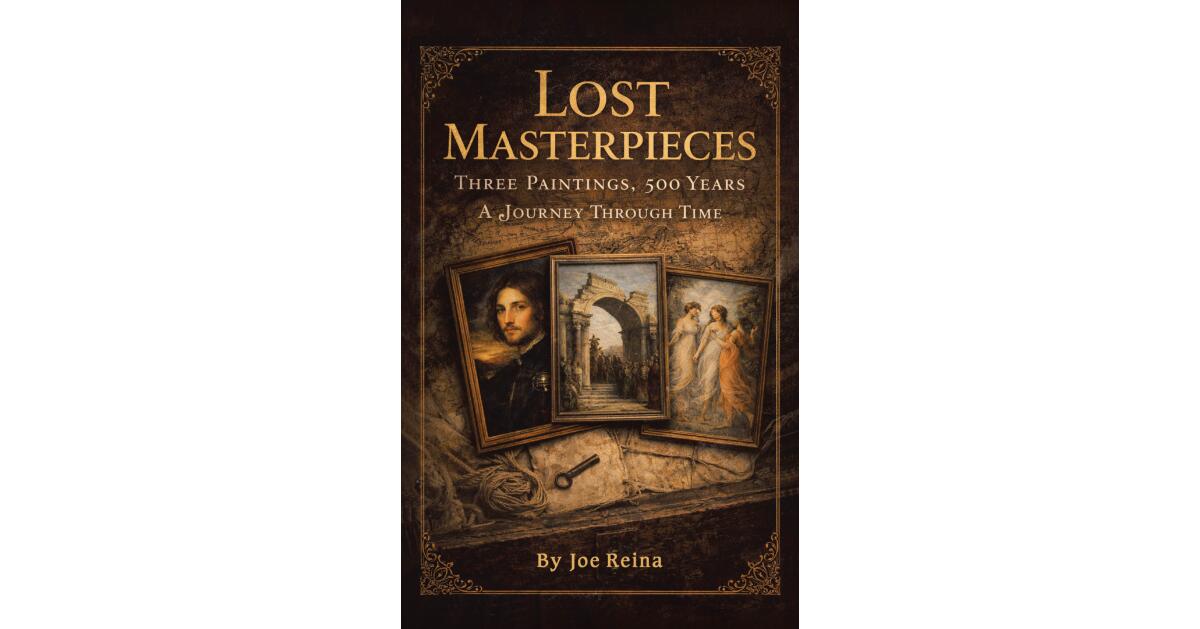
Joe Reina has published a new novel, "Lost Masterpieces: Three Paintings, 500 Years A Journey Through Time," built around an imagined scene from Renaissance history: the night before Leonardo da Vinci leaves for Milan, when three fellow painters each hand him a small work carrying a private message.
According to the announcement, those three gifts come from Sandro Botticelli, Titian, and Andrea Mantegna, each painting standing in for a different kind of counsel. Botticelli’s piece is described as layered with allegory and coded warnings about power and patronage. Titian’s is framed as warm and sensual, suggesting reinvention and a break from convention. Mantegna’s is austere and classically precise, encoding discipline and endurance. According to the announcement, these three paintings form a wordless exchange between masters, transmitting wisdom, mutual regard, and assurance across generations through visual means.
Reina comes to this material from outside the art world. His career was built in apparel, footwear, and real estate development in Chicago, and the publisher’s materials trace his interest in European history, and in Italy specifically, to years of international business travel. He has published several previous books, including "The Goat Sleeps in the Kitchen," "A Love Affair in Tuscany," and "Shadows over Scottsdale," before turning to this account of a fictionalized moment at the hinge of the Renaissance.
"I wanted to capture that extraordinary moment when masters speak to each other across time through their work," Reina said in the announcement. "These paintings represent not just gifts, but a conversation about what it means to pursue greatness while remaining grounded in purpose and principle."
The book is published through Covenant Books and is available in hardcover and paperback, as well as through Apple Books, Amazon, Google Play, and Barnes & Noble.
Studio CarryOnHarry is intrigued by novels that build fiction around real historical figures at a specific, dramatized turning point rather than attempting straight biography — the approach succeeds or fails based on how seamlessly the fictional moment integrates with documented historical fact.
Read more People’s Choice stories on Studio CarryOnHarry. Reporting via Live News Vault.
Are you an author with a new release? We’re always looking for books to cover and authors to interview — tell us about yours here.
Press Releases at Studio CarryOnHarry
Related Posts
Katt Taylor’s New Novel Follows a Woman’s Fractured Spirit from Darkness to Awakening
Balle Balle Radio™ Entertainment Desk Katt Taylor has released "The Mental Woman Within," a novel tracing the spiritual unraveling and…
New Children’s Book ‘Mocha, the Ground Fairy’ Follows a Guinea Pig Determined to Fly
Balle Balle Radio™ Entertainment Desk Dr. Leslie Merida-Gonzalez has published a new children's book, "Mocha, the Ground Fairy," through Fulton…
Fulton Books Author Abagail Lynn Releases Fantasy Adventure “The Rebel”
Balle Balle Radio™ Entertainment Desk Abagail Lynn has released a new novel, "The Rebel," a fantasy adventure centered on an…
Retired Sacramento Pulmonologist Pitches Self-Monitoring Alternative to Health-Care Bureaucracy in New Book
Balle Balle Radio™ Entertainment Desk Del Meyer, a Sacramento-based pulmonologist, has authored a book contending that the central challenge in…
Anthony V. Pugliese Expands 2020 Horror Collection in New Edition of “All Things Truly Wicked”
Balle Balle Radio™ Entertainment Desk Anthony V. Pugliese has released a second edition of "All Things Truly Wicked," an expanded…

STEERus Rolls Out Free Tool and Webinar on How AI Describes Small Businesses to Customers
Balle Balle Radio™ Entertainment Desk STEERus Inc. has launched a free online assessment called the Digital Signal Check, intended to…
-

 Books4 days ago
New Children’s Book Pairs Faith Themes With a Mystery About Fruit Jars and a Vanished Town
-

 Books6 days ago
Sonoma County Memoir “My Wine Country” Recounts Author Victor Sanchez Jr.’s Path Through Hardship
-

 Books4 days ago
Christian Faith Publishing Releases Daniel Kelsey’s “Hidden Treasures in Secret Places”
-
 Books4 days ago
New Children’s Book ‘Sally’s First Day of School’ Frames Bullying Through a Lens of Faith
-

 Books3 days ago
Nancy Chance’s New Book Traces Fallen Angels and Ancient Origins Through Biblical Texts
-
 Books2 days ago
Anthony V. Pugliese Expands 2020 Horror Collection in New Edition of “All Things Truly Wicked”