
Books
New Faith-Based Marriage Guide Draws on Author’s Clinical Background and Relationship Experience

Balle Balle Radio™ Entertainment Desk
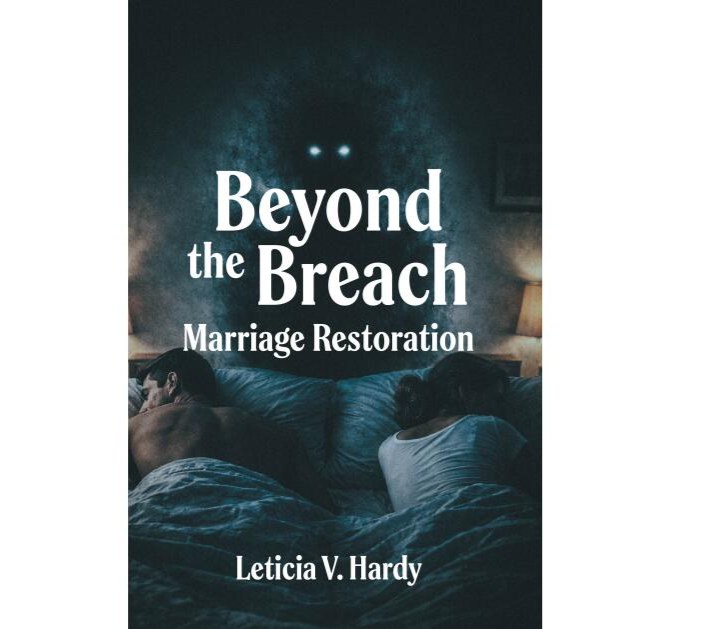
Leticia V. Hardy has published "Beyond the Breach: Marriage Restoration," a guide for couples navigating betrayal, emotional distance, financial hardship, and spiritual warfare, according to the announcement. The book was published through Christian Faith Publishing.
With a master’s degree in marriage and family therapy and a marriage spanning nearly two decades to her high school sweetheart, per the announcement. She writes from that combination of clinical training and personal experience, describing a period in her own marriage when she says time spent on ministry and service to others came at the expense of her presence at home. That realization, according to the announcement, pushed her toward what she describes as better boundaries and more deliberate attention to her marriage.
The work explores hidden wounds to marital unity—emotional unavailability, communication fractures, spiritual disconnection, and intimacy deprivation between partners. The publisher’s description positions the book as arguing that these problems often build gradually, through absence rather than a single rupture, and that restoration is possible when couples realign around shared faith.
"My prayer is that every couple who opens this book recognizes that their marriage is worth fighting for, that God desires their restoration more than they do, and that transformation begins the moment we invite Him to step into our most intimate spaces," Hardy said in the announcement.
Readers can purchase the book at bookstores nationwide or online via Amazon, Apple iTunes Store, Google Play, and Barnes and Noble.
Studio CarryOnHarry notes that Hardy’s approach — pairing a therapy credential with a personal account of marital strain — is a common structure in the faith-based self-help category, and its reception will likely depend on how readers weigh personal testimony against clinical grounding.
Studio CarryOnHarry Perspective
There’s a genuine appetite for marriage guidance rooted in faith rather than secular psychology alone. Readers seeking this come not just from crisis but from a desire to integrate their spiritual convictions with practical repair—a need that mainstream relationship advice often leaves unaddressed. Hardy’s book speaks directly to couples who view their marriage through a theological lens, where God’s role in restoration isn’t metaphorical but central.
This niche thrives precisely because marriage strain doesn’t stop at emotional or financial dimensions; for many couples, spiritual misalignment or a sense that faith has been neglected feel like core ruptures. A therapist might diagnose "emotional distance," but a believer might experience it as "we’ve stopped praying together." The market for books that name both the clinical and the sacred problem—and treat them as inseparable—reflects how incomplete many readers find either framework alone.
Where the category can blur is between literature that genuinely integrates therapy principles with faith tradition, and work that primarily uses clinical credentials as reassurance while centering personal testimony. The announcement emphasizes Hardy’s master’s degree alongside her own marriage narrative, but doesn’t detail how clinical evidence shapes her restoration model versus how her faith convictions drive it. Readers should enter aware of that distinction.
The lasting value of faith-based marriage books may depend less on whether they "out-perform" secular counseling models and more on whether they help couples recognize their own values reflected back at them—then act. For believers, that recognition can be the permission slip to take their marriage seriously as a spiritual practice, not just a relationship to manage.
Read more People’s Choice stories on Studio CarryOnHarry. Reporting via Live News Vault.
Are you an author with a new release? We’re always looking for books to cover and authors to interview — tell us about yours here.
Press Releases at Studio CarryOnHarry
Powered by SgAiSolution
Related Posts
Taking One Step Forward and Two Steps Back? Why Your “Slow Growth” Is Actually Working
We live in a culture obsessed with the "overnight transformation." Our feeds are packed with dramatic before-and-after photos, rapid success…

The Loneliest Feeling in the World: Why We Feel Deeply Disconnected in a Connected World
There is a unique kind of exhaustion that comes from being in a room with someone you love, only to…

Sick of Loud, Fast-Paced Plots? Why “Quiet Fiction” Is the Emotional Escape You Need Right Now
We live in a world that refuses to slow down. Our social media feeds are a non-stop rush, our TV…

Unleash Your Inner Creator with The Football League Activity Book
Every football fan knows the feeling. The match is over, the weather outside is miserable, or you are stuck on…

“The Oxford Handbook of Eating Disorders” Offers Clinicians a Field-Wide Reference
Balle Balle Radio™ Entertainment Desk W. Stewart Agras edited "The Oxford Handbook of Eating Disorders," which debuted in 2010 as…

New Book from New Jersey Educator Applies Socratic Questioning to the Four Gospels
Balle Balle Radio™ Entertainment Desk Frank Heelan, a longtime New Jersey educator, has released "The Way of Jesus God-Man and…

Authors and Artists
Taking One Step Forward and Two Steps Back? Why Your “Slow Growth” Is Actually Working
- The Reality of Fluctuating Days: Acknowledging that sometimes life feels uncertain, repetitive, or completely stationary—and that this isn’t a failure, but a natural part of the human rhythm.
- Patience Over Self-Criticism: Breaking the cycle of modern guilt by teaching you to replace internal judgment with absolute, unapologetic self-grace.
- The Power of Subtle Shift: Showing how every single time you choose to try again after a setback, you are quietly evolving into someone steadier and softer—even if you can’t see it yet.
Powered by SgAiSolution
Related Posts
The Loneliest Feeling in the World: Why We Feel Deeply Disconnected in a Connected World
There is a unique kind of exhaustion that comes from being in a room with someone you love, only to…
Sick of Loud, Fast-Paced Plots? Why “Quiet Fiction” Is the Emotional Escape You Need Right Now
We live in a world that refuses to slow down. Our social media feeds are a non-stop rush, our TV…
Unleash Your Inner Creator with The Football League Activity Book
Every football fan knows the feeling. The match is over, the weather outside is miserable, or you are stuck on…

Two new consciousness‑style paperbacks on Amazon
Two new consciousness‑style paperbacks on Amazon, Author Ruby Dosanjh has released, expanding a growing body of atmospheric, introspective fiction. The…

Likewise now available on Kindle.
Likewise is a story built in the spaces between words. About presence that feels too precise. About the kind of…

Need a Diet Pal?
Meet DR PAL: Protein Diet Pal and DR PAL: High Fibre Diet Pal — two practical guides built for real‑world eating, not fad rules. Each book gives you structured…
Authors and Artists
The Loneliest Feeling in the World: Why We Feel Deeply Disconnected in a Connected World

- Mismatched Perspectives: The haunting tension born when two people experience the exact same moment in completely contradictory ways.
- The Weight of the Unspoken: How the things we choose not to say create permanent, invisible barriers in our closest relationships.
- The Grace of Letting Go: A deeply empathetic look at the natural, inevitable drift that happens when two lives simply move in opposite directions.
Powered by SgAiSolution
Related Posts
Taking One Step Forward and Two Steps Back? Why Your “Slow Growth” Is Actually Working
We live in a culture obsessed with the "overnight transformation." Our feeds are packed with dramatic before-and-after photos, rapid success…
Sick of Loud, Fast-Paced Plots? Why “Quiet Fiction” Is the Emotional Escape You Need Right Now
We live in a world that refuses to slow down. Our social media feeds are a non-stop rush, our TV…
Unleash Your Inner Creator with The Football League Activity Book
Every football fan knows the feeling. The match is over, the weather outside is miserable, or you are stuck on…
Two new consciousness‑style paperbacks on Amazon
Two new consciousness‑style paperbacks on Amazon, Author Ruby Dosanjh has released, expanding a growing body of atmospheric, introspective fiction. The…
Likewise now available on Kindle.
Likewise is a story built in the spaces between words. About presence that feels too precise. About the kind of…
Need a Diet Pal?
Meet DR PAL: Protein Diet Pal and DR PAL: High Fibre Diet Pal — two practical guides built for real‑world eating, not fad rules. Each book gives you structured…
-

 People's Choice2 days ago
Haivaan Isn’t Really an Akshay Kumar Film — And That’s the Problem
-

 Art & Entertainment5 days ago
Netflix’s October 2026 Slate: ‘East of Eden’ Adaptation, Ben Affleck Thriller, ‘Diplomat’ Season 4
-

 People's Choice6 days ago
Ramayana’s Ravan Problem: When Marketing Outpaces Meaning
-

 Podcasts5 days ago
The Lost Art of Listening in an Age of Endless Talking
-

 People's Choice4 days ago
One Blockbuster, One Miracle, One Flop: What Toxic, Hanuman Anshakar and Mirzapur Reveal About India’s Box Office Logic
-

 Editor's Choice5 days ago
Ajay Devgn’s Crime Patrol Gamble: Star Power on a TV Budget