NEW YORK, December 22, 2022 (CarryOnHarry.com)
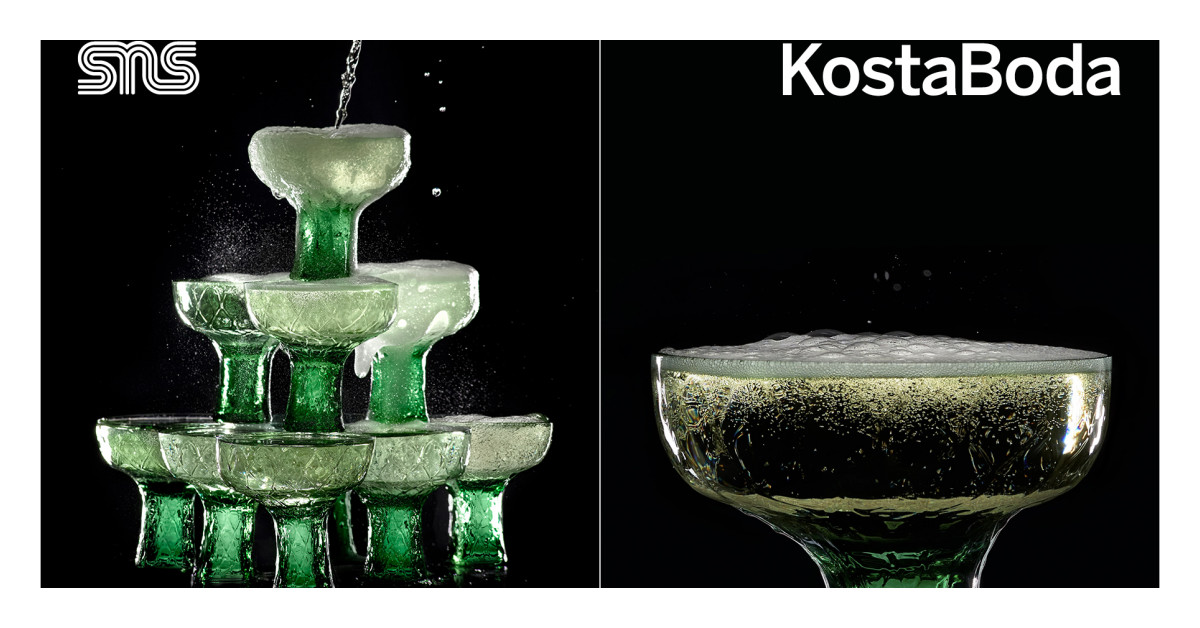
– The historically acclaimed design and crystal glass manufacturer Kosta Boda is excited to collaborate with the internationally known Sneakers and Stuff (SNS) by launching a new and unique coupe crystal glass.
From traditional craftsmanship to the creation of modern art and design objects, the Swedish brand, Kosta Boda, has remained the largest crystal manufacturer since its establishment in 1742. After almost 300 years, Kosta Boda joined forces with SNS, mixing both brands’ DNA by designing a one-of-a-kind champagne glass dubbed “Champs” (Champagne + Champion = Champs). The Champ glass is inspired by the offseason, where athletes and the public recharge with a glass of bubbles, and the coupe takes influence from the net of a basketball hoop. The glass is mouth-blown and handmade in Sweden, making each of the 1,000 glasses uniquely beautiful.
The Champs glass is available as a set of 2, accompanied by a premium cotton tee and a basketball with co-branded artwork that celebrates the collaboration.
To view visual content from SNS x Kosta Boda, click HERE.
About Kosta Boda
Kosta Boda is a historically celebrated crystal brand that offers bold, brave, and artistic glass and interior design objects derived from Swedish design tradition. Since the first furnace was ignited at Kosta Glassworks in 1742, Kosta Boda has produced premium glassware for royalty and nobility. Today, the progressive assortment also targets the modern lifestyle with products essential to everyday life. Kosta Boda is one of the largest art glass suppliers in the world that works with internationally acclaimed artists such as Bertil Vallien, Kjell Engman, and Åsa Jungnelius.
SNS was founded in 1999 out of love and curiosity for the culture and life around Sneakers, Fashion, Art, Music, and Basketball. Today SNS is a global brand with a physical presence in New York, Los Angeles, Tokyo, Paris, London, Berlin, and Stockholm. SNS works through four main pillars: SNS Brand, SNS Entertainment, SNS Retail, and SNS Cares, all focused on Culture, Creativity, and Community with the goal to connect locally in a global way.
Gunmaaster G9 Teaser Review: Emraan-Himesh Reunion Delivers Organic Mass Signal — But November 27 Will Be the Real ISI Mark
MassMasala — Studio CarryOnHarry Trade Desk
August 25, 2026. The Gunmaaster G9 teaser dropped at 82 seconds flat, and the first question any trade analyst should ask is not “how many views?” The first question is: did the footage earn the buzz, or did the PR machine manufacture it?
Let’s be straight. This teaser earned it.
The ground signal within hours of the drop was not driven by celebrity retweets or studio-orchestrated fan clubs posting simultaneously — woh pattern alag dikhta hai, log soong lete hain. What trended was Himesh Reshammiya’s “Afsana Banaaya Aapne” — a song tied to a 2006 film that its fanbase never let die. When a two-decade-old hook resurfaces organically in 2026 audience chatter, that is not nostalgia marketing. That is a dormant fanbase reactivating. These are real people who will buy tickets.
The footage itself is structured correctly for its target audience. Emraan Hashmi in a desi avatar, raw dialogue delivery, high-stakes fight choreography, a Mahadev prayer for his beloved — yeh mass entertainer ka grammar hai, aur yahan koi translation nahi ho raha. It is being spoken in the original language to the original audience. Director Aditya Datt — who established this grammar with Emraan in Aashiq Banaya Aapne and Dil Diya Hai — clearly has not forgotten how to write the sentence.
Contextually, Awarapan 2 was the proof of concept. It demonstrated that Emraan’s theatrical equity was not dead — it was just waiting for the correct film. Gunmaaster G9 is the next transaction in that rebuilt account. Add Genelia D’Souza’s return to Hindi theatrical — an angle the trade is criminally underweighting — and Aparshakti Khurana’s ensemble credibility, and the casting calculus makes sense.
One flag: Aditya Datt publicly claimed this will be “bigger than Aashiq Banaya Aapne.” Director saab, teaser toh strong hai — but that is a bar set publicly, and November 27 will collect accordingly. You can manipulate a headline. You cannot manipulate a hall.
Verdict: Organic mass entertainer setup. Genuine nostalgic currency backed by real footage energy. Mixed bag risk only on the November 27 release date competition. Box office does not lie — aur yeh film ab tak jhooth bolti nahi dikh rahi.Editor’s VerdictThe machinery of Bollywood hype is loud, rehearsed and increasingly easy to see through — which is precisely why when something cuts through without the usual orchestration, it deserves a measured acknowledgement. This teaser worked because the nostalgia it activated was not manufactured; it was waiting. A dormant fanbase is fundamentally different from a constructed one — they return with genuine intent, not algorithmic obligation. The Genelia angle is the most undervalued element here commercially, because her return to Hindi theatrical carries its own emotional weight across a demographic that Hindi cinema has largely ignored lately. The director’s public “bigger than Aashiq Banaya Aapne” declaration is the one variable that could quietly become a liability — ambition announced is accountability accepted, and exhibition does not trade in sentiment. The real story of this campaign will not be written in August 2026; it will be written in the cold arithmetic of November 27’s opening day numbers.
Beyond the headlines, a dormant fanbase reactivating on its own terms is worth more to a film than any marketing budget ever designed to simulate exactly that.
Arijit’s Exit Unlocks Shaan’s Private Battle With Playback Singing
Studio CarryOnHarry Entertainment Desk | 23 August 2026
Veteran Bollywood singer Shaan has opened up about a deeply personal crossroads in his career — a moment when he seriously considered walking away from playback singing altogether. His candid confession comes in the wake of Arijit Singh’s headline-making decision to step back from film playback work, which has been one of the most talked-about developments in Bollywood’s top stories of 2026.
Shaan Opens Up on Arijit Singh’s Departure
Speaking in a candid conversation with veteran trade analyst Komal Nahta, Shaan was quick to offer some nuance around Arijit’s situation. He noted that Arijit hasn’t retired from singing entirely and has reportedly recorded a substantial volume of songs that are yet to see a public release.
“In the next two years, you’ll get to hear a lot of Arijit Singh,” Shaan remarked, adding that nothing is set in stone and the acclaimed singer could very well change his mind down the line.
The Personal Dilemma Shaan Faced in His Thirties
Shaan then turned the lens on himself, revealing that around the age of 33–34, at a point when his career was flourishing and awards were coming his way, he found himself questioning his path. A strong pull toward social work and community service made him feel that his relentless schedule was leaving no room for anything beyond music.
Singing for Everyone — A and B-Grade Films Alike
Unlike Arijit Singh, who rose swiftly to the top and became highly selective about the projects he accepted, Shaan took a very different approach. He would leave home early each morning and lend his voice to films across every budget category — from prestige productions to smaller, independent ventures.
Fellow singers KK and Sonu Nigam repeatedly advised him to be more selective
Their message was direct: “Don’t sing all kinds of songs. Keep your standard, bro”
Shaan, however, found it impossible to decline when approached with warmth and affection
A Legacy Rooted in Family and Gratitude
Shaan’s deep ties to the industry made turning down requests especially difficult. His grandfather was lyricist Jahar Mukherjee, and his father was the late, celebrated music director Manas Mukherjee. Colleagues of his father and their families would often approach Shaan for playback work — and saying no felt like a betrayal of those bonds.
“I got a lot of blessings from them,” Shaan reflected, suggesting that those experiences, however commercially varied, enriched his journey in ways that go beyond awards or chart positions. For broader entertainment industry coverage, this kind of insider perspective rarely surfaces so honestly.
Studio COH Perspective
Shaan’s revelation adds vital context to the ongoing conversation about artistic identity in Bollywood’s playback ecosystem. When icons like Arijit Singh step back and legends like Shaan admit to their own moments of doubt, it signals a deeper reckoning within the industry. The pressures of loyalty, legacy, and commercial demand are forces every artist navigates — and these honest conversations help fans and industry watchers alike understand the human cost of a career in the spotlight.
– Entertainment Desk, Studio Carry On Harry
Background & Timeline
Shaan, born Shantanu Mukherjee, comes from one of Bollywood’s most storied musical families. His grandfather was lyricist Jahar Mukherjee, his father the late music director Manas Mukherjee, and his sister is singer Sagarika. Shaan rose to prominence in the late 1990s and 2000s, becoming one of Hindi cinema’s most versatile voices. In 2026, Arijit Singh’s announcement of stepping back from film playback singing reignited broader discussions about artistic burnout, selectivity, and the personal toll of a high-demand creative career in Bollywood.
Studio CarryOnHarry Perspective
At Studio Carry On Harry, we see Shaan’s candid revelation as a mirror held up to an industry that rarely pauses to reflect. When two of Bollywood’s greatest voices — Arijit Singh and Shaan — both arrive at moments of existential doubt, it tells us something profound about the cost of creative generosity. Shaan’s story, rooted in family loyalty and an open heart, is a reminder that behind every beloved song is a human being navigating impossible choices. That’s the Bollywood story worth telling.
What’s Next?
Watch closely for any further statements from Arijit Singh regarding his playback future, and keep an eye on whether Shaan takes on a more selective approach to his projects in the coming months. With a reported two years’ worth of Arijit recordings still to release, the conversation around Bollywood’s golden-voiced generation is far from over.
Editor’s Verdict
Shaan’s candour here is rarer than it appears. Two celebrated voices, two very different careers, yet both arrived at the same quiet question — is this still worth it? What’s striking is that Shaan’s hesitation wasn’t about fame or fatigue, it was about meaning. He kept saying yes not out of commercial calculation but out of inherited loyalty, the kind that doesn’t show up on a streaming dashboard. That generosity cost him selectivity but gave him something else entirely — a career woven into the fabric of the industry rather than positioned above it. Whether that trade-off was wise is genuinely debatable, but it was deeply human. Beyond the headlines, the most enduring voices in Bollywood may not be the ones who guarded their legacy most carefully, but the ones who gave it away most freely.
Studio Ki Raye
Arijit ka playback se step back lena ek bada news moment tha — lekin Shaan ki baat ussse zyada revealing hai. Arijit ki selectivity ek luxury thi jo overnight stardom ne di. Shaan ka model bilkul ulta tha — har film, har budget, har request. KK aur Sonu Nigam jaisa industry ka koi bhi singer yahi advice deta, lekin Shaan ke liye “standard maintain karna” ek emotional option nahi tha jab baap ke saathiyon ke bachche darwaza khadkhaate the. Yeh sirf nostalgia nahi hai — yeh ek important reminder hai ki Bollywood mein loyalty aur legacy kabhi kabhi artistic identity se bhaari pad jaati hai. Aur is industry mein jo log sab kuch lete hain, woh aksar woh hote hain jinhe “no” kehna sikhaya hi nahi gaya.