
People's Choice
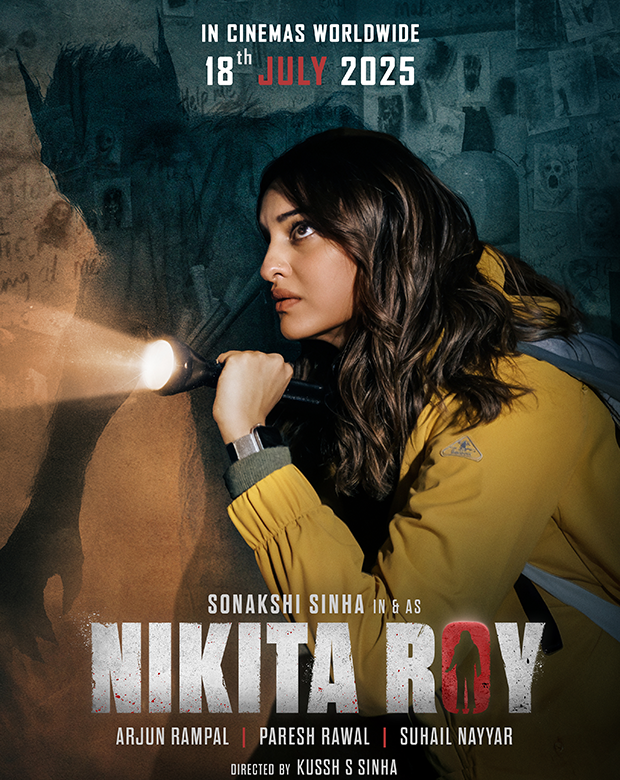
Film Review | Nikita Roy — A Supernatural Thriller That Challenges the Line Between Truth and Illusion

Film Review | Nikita Roy — A Supernatural Thriller That Challenges the Line Between Truth and Illusion
By: [Studio CarryOnHarry], Film Correspondent
In an era where Bollywood frequently leans on formulaic thrillers or love stories, Nikita Roy comes as a rare and refreshing surprise. Directed by debutant Kush Sinha and headlined by Sonakshi Sinha, this film dares to dive deep into a subject that Indian cinema has largely left unexplored: the intersection of science and superstition.
Set against a backdrop where blind faith often masquerades as truth, Nikita Roy follows the journey of its titular protagonist — a scientific investigator and author — as she sets out to debunk societal myths and confront those who propagate fear in the name of the supernatural. But when her investigation leads her to a chilling encounter with a manipulative spiritual figure (played masterfully by Paresh Rawal), the film shifts gears. From rational inquiry, we are plunged into a world teeming with illusion, eerie occurrences, and questions about the very nature of reality.
The slogan, “The biggest lie is the truth,” lingers throughout the narrative like a haunting whisper, challenging viewers to reconsider what they believe and why.
Performances:
Sonakshi Sinha delivers what can easily be called one of the most mature performances of her career. As Nikita, she embodies determination, intellect, vulnerability, and fear with astonishing ease. Her character is the soul of the film, and Sonakshi breathes life into every frame she occupies. It’s the kind of role that redefines an actor’s career arc.
Paresh Rawal, as the enigmatic antagonist, is magnetic. From the subtle menace in his voice to the unpredictability of his actions, he keeps the audience on edge. You’re never quite sure whether to believe him — and that’s exactly what the film wants.
Arjun Rampal, in a supporting yet pivotal role, brings gravitas and mystery, rounding off a cast that is wholly committed to the eerie and atmospheric tone of the film.
Direction & Technical Brilliance:
Kush Sinha’s directorial debut is nothing short of impressive. His command over tone, pacing, and narrative complexity does not betray his newcomer status. There’s a confidence in the storytelling — a refusal to spoon-feed the audience, allowing ambiguity and suspense to build naturally. The film does not rely on cheap jump scares; instead, it invokes a slow-burning psychological tension that is far more effective.
Cinematography plays a crucial role in enhancing the supernatural overtones. Dimly lit corridors, crumbling buildings, shadowy figures — every frame is carefully constructed to keep the viewer guessing. The background score is sparse but unsettling, a companion to Nikita’s descent into the unknown.
Final Verdict:
Nikita Roy is more than just a thriller — it is a commentary on the fine line between belief and manipulation, between reality and perception. It questions whether truth is a matter of fact, or just the loudest story being told.
This is a rare film in Hindi cinema that refuses to conform, and for that alone, it deserves applause. Add to that stellar performances and confident direction, and what you have is a Friday treat not to be missed.
Rating: 4 out of 5 stars
Powered by SgAiSolution
Related Posts

Haivaan Isn’t Really an Akshay Kumar Film — And That’s the Problem
Balle Balle Radio™ Entertainment Desk Marketed around its biggest star, Haivaan quietly hands its story to Saif Ali Khan while…

Spirit Is Stuck in Rewrites — And Prabhas Is Running Out of Time to Prove He’s Still a Star
Balle Balle Radio™ Entertainment Desk Sandeep Reddy Vanga's Spirit has reportedly paused shooting over a weak interval scene, pushing the…

Drishyam 3: Can Ajay Devgn’s Franchise Survive Without Its Own Story?
Balle Balle Radio™ Entertainment Desk As Drishyam 3 heads toward its October 2 release with a new cast pairing of…

One Blockbuster, One Miracle, One Flop: What Toxic, Hanuman Anshakar and Mirzapur Reveal About India’s Box Office Logic
Balle Balle Radio™ Entertainment Desk A gritty streaming-style thriller with no mega-star, a two-crore devotional film that quietly crossed fifty,…

Ramayana’s Ravan Problem: When Marketing Outpaces Meaning
Balle Balle Radio™ Entertainment Desk A poster controversy around India's most expensive film has exposed a deeper tension between visual…
Mirzapur Proves the Screen-to-Cinema Leap Can Work — But the Numbers Tell a More Complicated Story
Balle Balle Radio™ Entertainment Desk The web-to-film adaptation of Mirzapur has opened strongly at the box office, but its real…


Balle Balle Radio™ Entertainment Desk
Fifteen years ago, an Indian esports competitor using the handle HI_ISTLER achieved a podium finish at the World Cyber Games in Busan, South Korea — a national first at esports’ biggest global event of the era. His name is Prince Johal, and the medal remains, to date, India’s only WCG podium finish.
Prince At the 2011 World Cyber Games World Championship Finals, Johal earned bronze in Carrom 3D, a billiards simulator created by Neoact. According to the official results as recorded on Wikipedia, gold went to Bulgaria’s Iliyan Ivanov Kiryakov, silver to Brazil’s Diego Adelino da Paz, and bronze to Prince Johal, ahead of Portugal’s fourth-place finisher.
The path there was not smooth. Johal first won India’s national qualifying finals to earn a place at the World Championship, where he was drawn into a group stage against three opponents, including the eventual silver and gold medalists. According to Sportskeeda’s article highlighting underrecognized Indian gamer accomplishments, he suffered defeats in all three group-stage contests. That left him fighting for bronze in a rematch against the same opponent who’d beaten him in the group stage — a Portuguese player competing as TwinS_KluB. This time Johal won the decider 3-0, according to the same account, to secure the medal.
An independently compiled archive of the 2011 tournament frames the result as evidence of the game’s reach beyond its core markets in Asia, noting Johal’s finish specifically in that context.
World Cyber Games ran as one of the major international esports championships through the 2000s and into the early 2010s, drawing national teams and qualifying tournaments across dozens of countries before the org’s format and prominence shifted in later years. A bronze at the 2011 finals placed Johal on a very short list of Indian competitors who had reached a WCG podium at all.
Read more People’s Choice stories on Studio CarryOnHarry. Reporting via Live News Vault.
Press Releases at Studio CarryOnHarry
Powered by SgAiSolution
Related Posts

Netflix UK Debuts Full ‘Twilight’ Franchise and ‘Dune: Part Two’ in Major Content Drop
Balle Balle Radio™ Entertainment Desk This week's Netflix UK refresh includes all five "Twilight" installments alongside Denis Villeneuve's "Dune: Part…

Ajay Devgn’s Crime Patrol Gamble: Star Power on a TV Budget
Balle Balle Radio™ Entertainment Desk A Bollywood A-lister fronting a long-running true-crime show has split opinion between those who see…

Bajpayee Transforms Into Gandhi in Sudhir Mishra’s Next
Bajpayee Transforms Into Gandhi in Sudhir Mishra's Next Studio CarryOnHarry Entertainment Desk | 6 September 2026 A Historic Casting Decision…

The Mismatch Problem: How Toxic Tried to Serve Too Many Masters at Once
Balle Balle Radio™ Entertainment Desk The most telling detail in this discussion isn't a plot complaint. It's a process confession.…
Dulquer’s I’m Game Loses Ground on Day 2 as Footfall Fails to Match Screens
Dulquer's I'm Game Loses Ground on Day 2 as Footfall Fails to Match Screens Studio CarryOnHarry Entertainment Desk | 5…
Mirzapur: The Movie Day 1 — Rs. 29.70 Crore Gross Beats Projections, But Weekend Hold Is the Real Verdict
Mirzapur: The Movie Day 1 — Rs. 29.70 Crore Gross Beats Projections, But Weekend Hold Is the Real VerdictMassMasala —…
Editor's Choice
Netflix UK Debuts Full ‘Twilight’ Franchise and ‘Dune: Part Two’ in Major Content Drop

Balle Balle Radio™ Entertainment Desk
This week’s Netflix UK refresh includes all five "Twilight" installments alongside Denis Villeneuve’s "Dune: Part Two," part of a 53-item slate comprising 36 films and 17 television series.
For the first time recently, Netflix UK now hosts the complete "Twilight" saga in one location: "Twilight" (2008), "New Moon" (2009), "Eclipse" (2010) and both parts of "Breaking Dawn" (2011, 2012). The franchise, adapted from Stephenie Meyer’s novels, made stars of Kristen Stewart, Taylor Lautner and Robert Pattinson, whose career since has spanned studio blockbusters and independent films, including a Time 100 mention in 2010 and a body of work that has grossed billions worldwide. These five installments shaped teen cinema of their generation, and their unified availability now allows UK viewers to experience the entire narrative arc on a single platform.
"Dune: Part Two," meanwhile, brings Villeneuve’s adaptation of Frank Herbert’s novel to the platform less than two years after its 2024 theatrical release. The film continues Paul Atreides’ story as he joins Chani and the Fremen against the forces that destroyed his family, with Timothée Chalamet and Zendaya starring. The film has already reached position 15 on Netflix UK’s movies rankings just days after arriving on the service, with further movement expected as the weekend approached.
The broader slate touches several genres and languages: French comedy "Call My Agent! The Movie" closes out that series’ run, alongside new arrivals including "Fauda" season five, "Physical 100: Italy" and Tyler Perry’s "Why Did I Get Married Again?" The latter title debuted at number eight on the platform’s movie chart in its first week, the announcement noted, with the sports documentary "Untold Mr. T: I Pity The Fool" close behind at number seven. Top of the chart was "The Whisper Man," followed by the documentary "Turning Point: Generation 9/11."
For Studio CarryOnHarry, the more interesting story here isn’t the blockbuster addition but the licensing pattern: pairing a two-year-old theatrical hit with a seventeen-year-old franchise suggests platforms are increasingly using nostalgia libraries to anchor subscriber attention around newer, splashier arrivals.
Read more People’s Choice stories on Studio CarryOnHarry. Reporting via Live News Vault.
Are you an author with a new release? We’re always looking for books to cover and authors to interview — tell us about yours here.
Press Releases at Studio CarryOnHarry
Powered by SgAiSolution
Related Posts

The Bronze Medal That Marked India’s Arrival in World Esports
Balle Balle Radio™ Entertainment Desk Fifteen years ago, an Indian esports competitor using the handle HI_ISTLER achieved a podium finish…
Ajay Devgn’s Crime Patrol Gamble: Star Power on a TV Budget
Balle Balle Radio™ Entertainment Desk A Bollywood A-lister fronting a long-running true-crime show has split opinion between those who see…
Bajpayee Transforms Into Gandhi in Sudhir Mishra’s Next
Bajpayee Transforms Into Gandhi in Sudhir Mishra's Next Studio CarryOnHarry Entertainment Desk | 6 September 2026 A Historic Casting Decision…
The Mismatch Problem: How Toxic Tried to Serve Too Many Masters at Once
Balle Balle Radio™ Entertainment Desk The most telling detail in this discussion isn't a plot complaint. It's a process confession.…
Dulquer’s I’m Game Loses Ground on Day 2 as Footfall Fails to Match Screens
Dulquer's I'm Game Loses Ground on Day 2 as Footfall Fails to Match Screens Studio CarryOnHarry Entertainment Desk | 5…
Mirzapur: The Movie Day 1 — Rs. 29.70 Crore Gross Beats Projections, But Weekend Hold Is the Real Verdict
Mirzapur: The Movie Day 1 — Rs. 29.70 Crore Gross Beats Projections, But Weekend Hold Is the Real VerdictMassMasala —…
-

 People's Choice5 days ago
Haivaan Isn’t Really an Akshay Kumar Film — And That’s the Problem
-

 People's Choice5 days ago
Drishyam 3: Can Ajay Devgn’s Franchise Survive Without Its Own Story?
-

 Art & Entertainment6 days ago
How a Career Box-Office Flop Became One of Prime Video’s Most-Watched Films
-

 Artists5 days ago
Song 1’s New EP “What The ….” Leans Into Five Tracks of Deliberate Disorder
-

 Books5 days ago
Craig Fadel’s ‘The Songless Bird’ Offers Children a Message of Self-Acceptance Through Musical Metaphor
-

 Books5 days ago
New Book from New Jersey Educator Applies Socratic Questioning to the Four Gospels