
Podcasts
The Lost Art of Listening in an Age of Endless Talking

Balle Balle Radio™ Entertainment Desk
Amid podcasts, interviews and endless streams of content, a simple observation about storytelling raises a harder question: are we actually listening to anything anymore, or just letting it pass through us?
There is a particular kind of stillness that has almost disappeared from public conversation. Not silence as absence, but silence as an active ingredient — the pause after a difficult answer, the beat before a follow-up question, the moment a listener actually processes what has just been said rather than reaching for the next thing to say.
That stillness is worth examining, because its disappearance says something about how we consume stories now, whether in interviews, films, memoirs or the constant scroll of short-form video that fills the gaps between everything else.
Kazuo Ishiguro once offered a definition of storytelling that is easy to nod along to and much harder to actually practise: stories are how we make sense of our own lives, and how we make sense of other people’s. It sounds almost too simple to be useful. But sit with it for a moment and the idea resists the usual framing of stories as entertainment, escape, or content to be consumed and discarded.
Mirrors, Not Escapes
The instinct to treat stories as escape is understandable. A film, a novel, an interview — these are often marketed and consumed as departures from ordinary life, a couple of hours where someone else’s problems replace our own. But Ishiguro’s framing suggests the opposite function. A story about someone else’s failure, resilience or reinvention doesn’t just distract from our own life — it hands us language for it. Someone else’s comeback becomes a way of understanding our own setbacks, even when the circumstances share nothing on the surface.
This reframes what listening actually requires. If a story is only escape, half-attention is enough. If a story is a mirror, half-attention means missing the reflection entirely.
That distinction matters most in the interview format, where the entire value of the exchange depends on what happens in the space between question and answer. A rushed follow-up, an interviewer already thinking about the next question while a guest is still finishing a thought — these are small failures, but they are failures of exactly the mechanism that makes an interview worth doing in the first place. The story might still get told. It just doesn’t get *received*.
There’s a reasonable objection here worth taking seriously: not every conversation needs to be a profound act of mutual understanding. Some interviews exist to deliver information quickly — a release date, a plot summary, a quick reaction. Demanding contemplative silence from every exchange would make for exhausting, self-indulgent media. The counterpoint holds. But it doesn’t undermine the core observation so much as narrow it. The claim isn’t that every conversation must slow down. It’s that the conversations we treat as meaningful — the long-form interview, the personal essay, the memoir, the character study — lose their actual value when they’re consumed at the speed of a scroll.
The Attention Economy’s Quiet Cost
This is where the observation stops being about storytelling craft and becomes something closer to a diagnosis of media culture more broadly. The modern information environment rewards volume and speed. Podcasts multiply, interview clips get chopped into ninety-second highlights optimised for algorithms, and the average viewer’s relationship to a story often consists of scrolling past a thumbnail, absorbing a headline, and moving on with the vague sense of having engaged with something.
None of that is inherently wrong. Short-form content has genuine value, and treating every piece of media as demanding deep contemplation is its own kind of pretension. But there’s a real difference between consuming a story and listening to one, and that difference tends to get lost in a media landscape optimised for throughput rather than depth.
Audiences aren’t necessarily choosing shallow engagement because they lack the capacity for deeper attention. More likely, they’re responding rationally to an environment that rarely asks anything more of them. If most interviews are edited for soundbites, if most narratives are structured for quick payoff, audiences learn — reasonably — that quick payoff is what’s on offer. The listener adapts to the format, not the other way around.
Studio Perspective
What’s genuinely interesting here isn’t the idea that stories help us understand ourselves — that’s a fairly old and well-established notion, stretching back through most of literary theory. What’s interesting is the specific claim about *where* that understanding actually happens: not in the story itself, but in the gap between the story and the listener. That’s a claim about process, not content, and it has implications that go beyond media criticism.
It suggests that the value of any given interview, film or narrative isn’t fixed at the point of creation — it’s partly determined by the quality of attention brought to it afterward. A brilliant answer delivered to a distracted room accomplishes less than a modest answer delivered to someone genuinely listening. That’s an uncomfortable idea for an industry built on production values, high-profile guests and polished delivery, because it locates a meaningful part of the value outside the control of the people making the content.
It also reframes what interviewers, editors and critics are actually responsible for. The instinct in media is to optimise for capturing attention — better hooks, tighter edits, more dynamic pacing. Those are legitimate craft concerns. But if the real transaction in storytelling happens in that space of reception, then some of the most important editorial decisions are about resisting the urge to fill every silence, cut every pause, and smooth over every moment where a guest — or a reader — needs a beat to actually process what just happened.
That’s a harder thing to measure than engagement metrics, and it’s probably why it gets deprioritised. But it might be the actual difference between content that gets consumed and disappears, and a story that genuinely changes how someone understands their own life.
The question worth sitting with isn’t whether stories matter — that’s rarely in dispute. It’s whether the conditions we’ve built for encountering them still leave room for anyone to actually listen.
— Studio CarryOnHarry Editorial Desk
Read more People’s Choice stories on Studio CarryOnHarry. Reporting via Live News Vault.
Powered by SgAiSolution
Related Posts

Toxic Isn’t a Bad Film Because It’s Ambitious — It’s a Confused Film Because It’s Several Films at Once
Balle Balle Radio Entertainment Desk Yash's long-awaited gangster epic promised a singular, era-defining spectacle. What audiences got instead was…

Episode 4 : Minutes of Wisdom with Emotional Intelligence
Hello and welcome to "Studio Carry On Harry in association with Balle Balle Radio Broadcast – Minutes of Wisdom", the…
Episode 3 : Minutes of Wisdom Goal Setting and Time Management.
Hello and welcome to "Studio Carry On Harry in association with Balle Balle Radio Broadcast – Minutes of Wisdom", the…
Minutes of Wisdom Episode 2 : Overcoming Self-Doubt and Building Confidence
Studio Carry On Harry in association with Balle Balle Radio Broadcast - Minutes of Wisdom has released a new episode…
Episode 5 : Minutes of Wisdom Success and Communication
Hello and welcome to "Studio Carry On Harry in association with Balle Balle Radio Broadcast – Minutes of Wisdom", the…

Podcasts
Toxic Isn’t a Bad Film Because It’s Ambitious — It’s a Confused Film Because It’s Several Films at Once
Balle Balle Radio Entertainment Desk
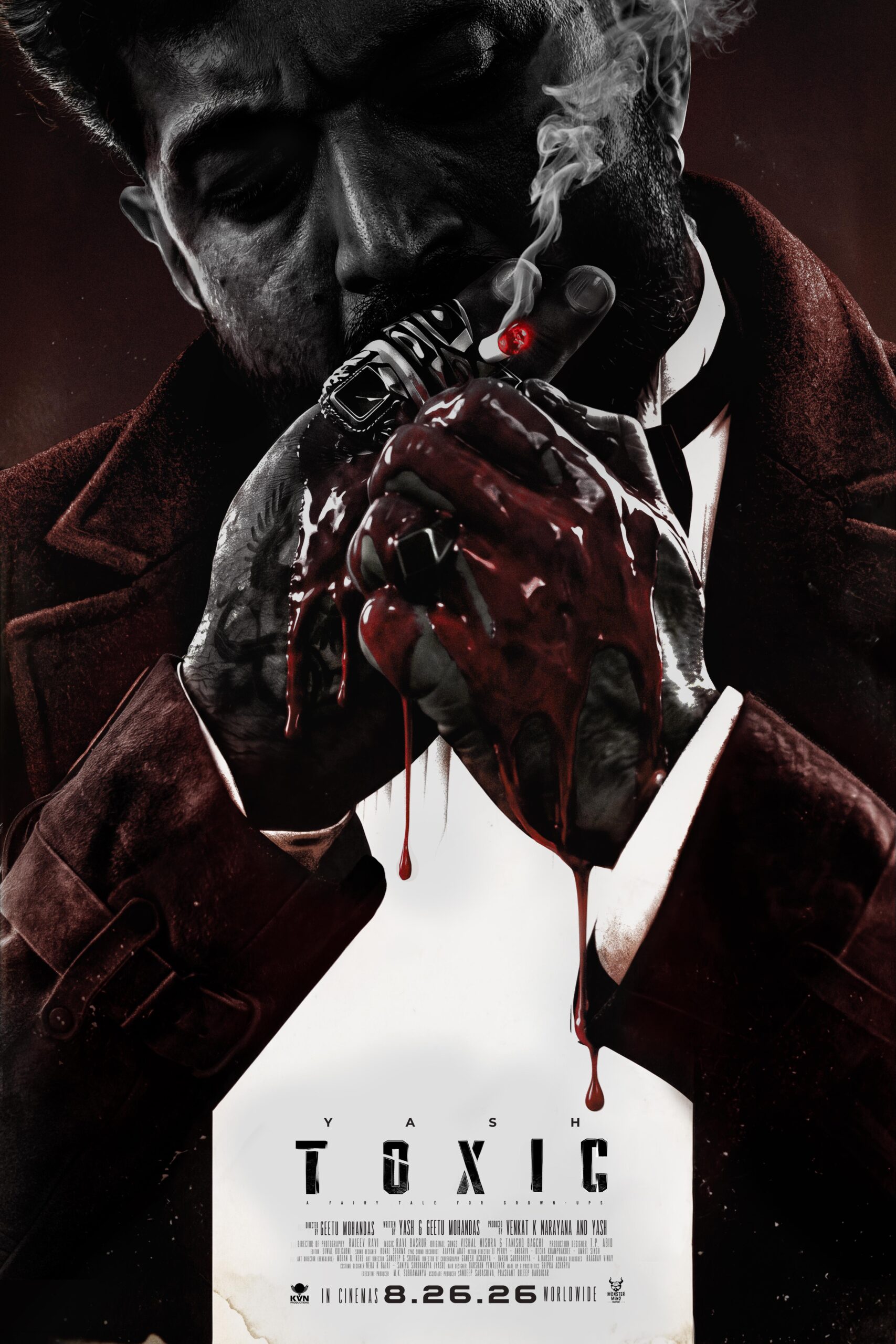
Yash’s long-awaited gangster epic promised a singular, era-defining spectacle. What audiences got instead was a screenplay pulled in too many directions by too many competing visions — and the friction shows in every overwritten line.
Toxic: When One Film Tries To Be Three Films At Once
There is a difference between a film that fails because it aimed too high, and a film that fails because it never decided what it was aiming at. Toxic belongs to the second category, and that distinction matters more than the box office numbers or the online discourse currently surrounding it.
The criticism directed at the film has often been framed as a punishment for ambition — as if audiences and critics are simply uncomfortable with a Kannada star attempting something bigger than a regional hit. That framing lets the film off too easily. Toxic’s problem isn’t scale. It’s coherence.
Strip away the marketing and look at what the film is actually trying to be. At its core, it wants to function as a large-scale gangster spectacle, built around female gaze aesthetics and Yash’s established mass-hero persona. But running underneath that is a second film — a darker, more psychological father-son drama, staged with the tonal ambitions of an art-house picture. Then there’s a third layer: the pan-India positioning, the multi-language shoot, the international framing, the insistence that this is not a regional film but a world event.
Three different films, one screenplay. None of them fully realized.
**A Screenplay Fighting Itself**
Toxic is credited to Yash and Geetu Mohandas, and the seams of that collaboration are visible throughout. Mohandas has spoken in interviews about her own process — writing one version, shooting another, editing into something else entirely by the time the film reaches the screen. That kind of instinctive, evolving filmmaking has a real tradition in independent cinema, where directors are given room to discover the film as they make it.
The difficulty is that Toxic isn’t an indie production. It’s a big-budget vehicle built around a major star’s image, audience expectation, and box-office pressure. A24-style improvisational filmmaking and tentpole-star cinema operate under fundamentally different rules. What reads as authorial risk-taking in a smaller film reads as structural confusion in a film this expensive and this loudly marketed.
The result is a screenplay where characters are introduced, given weight, and eliminated without their arcs ever paying off — a version of world-building that borrows the scale of Prashanth Neel’s KGF universe without the connective clarity that made that universe legible. Ambition isn’t the issue. Execution is.
The editing compounds the problem rather than correcting it. Sequences that might have landed with tighter framing are instead buried under excess length and unclear rhythm. Cinematography, performances, action choreography and production design have largely escaped criticism — it’s the story architecture underneath them that critics keep returning to.
**The Dialogue Problem: Depth as Performance**
Toxic’s dialogue writing deserves specific scrutiny, because it illustrates the film’s larger issue in miniature. Several exchanges strain visibly for profundity — metaphors about footprints erasing history, lines about real betrayal being more honest than manufactured loyalty. The intent seems to be philosophical weight. The effect, more often, is dialogue that announces its own depth rather than earning it.
There’s a useful analogy here: the smartest person in the room rarely needs to prove it out loud. Dialogue that insists on its own cleverness — that performs introspection rather than embodying it — tends to alienate rather than impress. Audiences are generally good at detecting when a film is telling them something is deep instead of simply being deep. Toxic’s screenplay leans into the former too often, and the effect compounds across a runtime already carrying too many competing ambitions.
**Why Alpha Got a Pass and Toxic Didn’t**
A useful comparison point is Alpha, released around the same period and also received unevenly — yet largely filed under harmless disappointment rather than genuine backlash. The difference isn’t quality parity. It’s expectation architecture. Alpha’s franchise was already understood to be in decline, and its marketing made no outsized claims about reinventing anything. Toxic did the opposite: extensive promotional messaging positioned it as a world event, a multi-language, internationally minded product built for audiences well beyond India, with Yash himself credited as actor, producer and co-writer, deeply embedded in the film’s creative machinery.
That level of declared ambition raises the cost of falling short. When a film explicitly tells its audience it is reinventing scale, and then delivers narrative confusion instead, the gap between promise and delivery becomes the story — regardless of how accomplished individual technical elements might be.
**A Familiar Collaboration Problem**
There’s historical precedent for what may be happening here. Bombay Velvet remains one of Hindi cinema’s most discussed cautionary tales about mismatched creative partnerships — an art-house-inclined director working with a major star, where Anurag Kashyap has since acknowledged, in his own words, that he could not fully deliver the traditional gangster-movie experience audiences expected from Ranbir Kapoor’s presence in the film.
Toxic risks repeating that pattern. The tension isn’t necessarily that Yash exerted too much control, or that Geetu Mohandas made too unconventional a film. The more plausible explanation is structural: a single film was being asked to satisfy Yash’s mass-audience expectations, a director’s psychological and tonal ambitions, and a producer’s pan-India commercial mandate — simultaneously, without one vision clearly subordinating to or integrating with the others.
**Studio Perspective**
The more interesting question Toxic raises isn’t whether the film succeeds or fails. It’s what happens when creative collaboration between a star with producing power and a director with an independent sensibility isn’t clearly negotiated before cameras roll.
Both instincts are legitimate on their own terms. A director drawn to psychological ambiguity and unconventional structure has every right to pursue that approach. A star seeking to expand his image into international, pan-India territory has every right to that ambition too. The failure isn’t in either desire individually — it’s in attempting to fulfill both inside a single, unreconciled screenplay, then compounding that indecision with editing that obscures rather than clarifies.
This is less a story about a film failing under the weight of ambition than a story about an industry still working out how much creative latitude a big-budget star vehicle can actually absorb. Independent cinema can survive a director discovering the film in the edit bay. A pan-India tentpole, carrying the expectations of an international audience and a superstar’s brand, generally cannot.
The deeper question worth sitting with isn’t whether Toxic overreached. It’s whether Indian cinema’s current pan-India moment is asking directors and stars to merge instincts that were never designed to merge — and calling the resulting confusion ambition, when it might simply be a lack of alignment.
— **Studio CarryOnHarry Editorial Desk**
Powered by SgAiSolution
Related Posts

The Lost Art of Listening in an Age of Endless Talking
Balle Balle Radio™ Entertainment Desk Amid podcasts, interviews and endless streams of content, a simple observation about storytelling raises a…
Episode 4 : Minutes of Wisdom with Emotional Intelligence
Hello and welcome to "Studio Carry On Harry in association with Balle Balle Radio Broadcast – Minutes of Wisdom", the…
Episode 3 : Minutes of Wisdom Goal Setting and Time Management.
Hello and welcome to "Studio Carry On Harry in association with Balle Balle Radio Broadcast – Minutes of Wisdom", the…
Minutes of Wisdom Episode 2 : Overcoming Self-Doubt and Building Confidence
Studio Carry On Harry in association with Balle Balle Radio Broadcast - Minutes of Wisdom has released a new episode…
Episode 5 : Minutes of Wisdom Success and Communication
Hello and welcome to "Studio Carry On Harry in association with Balle Balle Radio Broadcast – Minutes of Wisdom", the…
Hello and welcome to “Studio Carry On Harry in association with Balle Balle Radio Broadcast – Minutes of Wisdom”, the podcast where we share practical tips and strategies for personal development. I’m your host Mike, and in this episode, we’ll be talking about Emotional Intelligence.
Emotional Intelligence, or EI, is the ability to recognize and manage one’s own emotions, as well as being able to understand and respond appropriately to the emotions of others. It’s an essential skill for success in both personal and professional relationships, and it can help us navigate life’s challenges with greater ease and resilience.
But what exactly is EI, and why is it important? EI is made up of several different skills, including self-awareness, self-regulation, motivation, empathy, and social skills. Together, these skills help us understand and manage our own emotions, communicate effectively with others, and build strong, meaningful relationships.
So, how can we develop our EI and become more emotionally intelligent individuals? Here are some key tips:
Start by becoming more self-aware. This means paying attention to your own thoughts, feelings, and behaviors, and being honest with yourself about your strengths and weaknesses.
Practice self-regulation. This means being able to control your own emotions and impulses, even in challenging situations. One effective way to do this is through mindfulness meditation, which can help you develop greater emotional resilience and self-control.
Cultivate empathy. This means being able to understand and feel for others, even when you don’t necessarily agree with them. One way to develop empathy is by actively listening to others and trying to see things from their perspective.
Develop your social skills. This means being able to communicate effectively with others, build rapport, and establish meaningful relationships. One effective way to do this is by practicing active listening, giving and receiving feedback, and expressing yourself clearly and confidently.
Finally, make EI a priority in your daily life. This means being intentional about practicing the skills we’ve discussed, and seeking out opportunities to develop your emotional intelligence.
Remember, developing emotional intelligence is a lifelong journey, and it’s something that we can all work on and improve over time. By becoming more self-aware, regulating our emotions, cultivating empathy, and developing our social skills, we can become more emotionally intelligent individuals, and build stronger, more meaningful relationships with those around us.
That’s all for today’s episode of “Studio Carry On Harry in association with Balle Balle Radio Broadcast – Minutes of Wisdom”. We hope you found these tips helpful and inspiring. Don’t forget to share your experiences and feedback with us. Thanks for tuning in, and until next time, keep striving to develop your emotional intelligence!
Powered by SgAiSolution
Related Posts
The Lost Art of Listening in an Age of Endless Talking
Balle Balle Radio™ Entertainment Desk Amid podcasts, interviews and endless streams of content, a simple observation about storytelling raises a…
Toxic Isn’t a Bad Film Because It’s Ambitious — It’s a Confused Film Because It’s Several Films at Once
Balle Balle Radio Entertainment Desk Yash's long-awaited gangster epic promised a singular, era-defining spectacle. What audiences got instead was…
Episode 3 : Minutes of Wisdom Goal Setting and Time Management.
Hello and welcome to "Studio Carry On Harry in association with Balle Balle Radio Broadcast – Minutes of Wisdom", the…
Minutes of Wisdom Episode 2 : Overcoming Self-Doubt and Building Confidence
Studio Carry On Harry in association with Balle Balle Radio Broadcast - Minutes of Wisdom has released a new episode…
Episode 5 : Minutes of Wisdom Success and Communication
Hello and welcome to "Studio Carry On Harry in association with Balle Balle Radio Broadcast – Minutes of Wisdom", the…
-

 Editor's Choice4 days ago
Dulquer’s I’m Game Loses Ground on Day 2 as Footfall Fails to Match Screens
-
Podcasts4 days ago
Toxic Isn’t a Bad Film Because It’s Ambitious — It’s a Confused Film Because It’s Several Films at Once
-
Editor's Choice4 days ago
Mirzapur: The Movie Day 1 — Rs. 29.70 Crore Gross Beats Projections, But Weekend Hold Is the Real Verdict
-
Editor's Choice4 days ago
The OTT Gatekeepers Said No. Then ₹61 Crore Said Otherwise.
-

 Editor's Choice4 days ago
The Mismatch Problem: How Toxic Tried to Serve Too Many Masters at Once
-

 Editor's Choice3 days ago
Bajpayee Transforms Into Gandhi in Sudhir Mishra’s Next