
Editor's Choice
Interview with Subhrajit Mitra : Devi Chowdhurani…Bandit Queen of Bengal

Subhrajit Mitra‘s creative odyssey has been a tapestry woven with passion, learning, and an unwavering commitment to his vision. In this exclusive interview, we delve into the mind of Subhrajit Mitra, unraveling the intricacies of his creative process, the inspiration that fuels his stories, and the upcoming cinematic film that promises to captivate audiences worldwide. Join us as we venture into the heart of cinematic artistry with a director whose narratives resonate beyond the screen.
About You and Your background ? Lets begin days when you were aspiring to be , Days When you became what you are , professional upgrades in your journey?
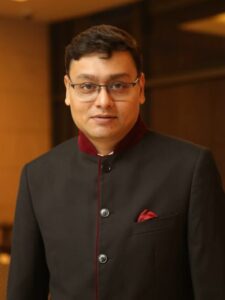 I have completed my bachelors degree in Computer science and Engineering from a premier university of India. After that I have done a certificate course in ancient Classical literature from the Harvard University and got my Honorary Doctorate in Literature from a reputed university of South India. I used to make documentaries for Government of India [ Defence and Home ministry ] and also for National Geographic Channel, Discovery and History Channel. I have learned the process of film making all by myself. Studying extensively in American ,British, German and Russian libraries and watching world classics in theatres and film festivals. I aspired to be a director, when I was 13/14 years old, after watching E.T. by Steven Spielberg in a theatre and pursued my dream ever since.
How do you convince yourself with things that you have to shoot for a film but you actually don’t otherwise believe?
I don’t shoot anything which I don’t believe in. simple, period. I am extremely choosy and strict about this from the very beginning. Absolutely no compromise, whatsoever.
Your Scripting Process ? Your approach to casting ?
I prefer classical literatures with historical background. Making period pieces gives the opportunity to research, to recreate the history which is fascinating. First if any classic literature appeals me, I start researching on the time period , the customs, the political and social scenario, the attires and many more detailed aspects. Then I study other notable literature and biographies of the noted personalities of that same time period for cross referencing and to incorporate that in my screenplay. And then I write the script organically. And I still use fountain pen to write a script rather than a computer as I prefer the human touch more.
Casting is very intuitive and organic process for me from the scripting stage itself.
How much does your life influences your story telling and the characters that you bring to life ?
To some extent, I try to incorporate my philosophical thoughts in the dialogues. I choose only those stories which is appealing to me personally, which I want to tell in the big screen.
How do you work on yourself to become better in your field learning, observing, reading ?
I am voracious reader. And I watch movies a lot. mainly films based on literatures. That’s the way I continuously upgrade myself.
Filmmaking is team work. Tell us about your team and what sort of pre planning gets done before you decide to make a film. Tough things about making films and what keeps you going despite those tough things ?
I choose my team according to the genre and subjects. If that means repeating someone, I don’t mind. But since I am working in the industry for quite sometime and best of the technicians and actors are all my friends, it’s easy to pick and choose for each individual project. They are all available for me as per my requirements. The kind of film I make, I do all the research, I choose the subject and the story, I write the screenplay, I do the production designing and I also Direct. So it takes longer than usual as I spearhead all these departments all by myself [ I have assistants in production design and directorial department only, and it’s by choice . But I enjoy the entire process. I don’t find it tough. Only the budget and finance factors are stressful for me, not the creative aspects.
Title Of Your New Release
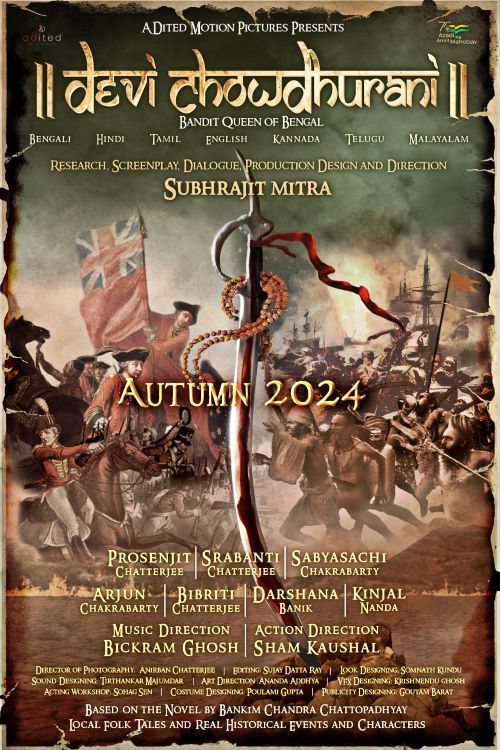
Devi Chowdhurani…Bandit Queen of Bengal
What is the central theme of film ?
I was studying and researching on the Battle of Plassey, Battle of Buxar, The Great Bengal Famine of 1770 and the Sanyasi and Fakir Rebellion which spans across this era. Off course this includes the advent and invasion of the British East India Company in India in it’s early years. Co-incidentally “Anandamath” and “Devi Chowdhurani” by Bankim Chandra Chattopadhyay are based on the similar timescale where I find the latter is more appealing in terms of a Film. It narrates a journey of a simple village girl who eventually becomes the first Indian woman freedom fighter, historically, against the colonial rule in India in the later part of the 18th century.
 I felt this story through my cinematic interpretation would be my humble homage to my Motherland in her 75th year of independence. It also tells the story of the Hindu ascetic monks who had no other option but to take up arms against the British colonial rules to save the country and her people. It was the first armed revolution by the Indians , led by Bhavani Charan Pathak, against the British East India Company. I only had to adapt the storyline into the alternative historical interpretation.
The basic plotline remains the same but almost 80% of the film is closer to the actual history, rather than the novel. It is built on the premise of “what might have actually happened”. Even Bankim Chandra Chattopadhyay wrote the novel almost after a 100 year of the original incidents. I had to study extensively from the archives of East India Company in London, several texts and manuscripts from Asiatic society, British Library, Victoria Memorial and Indian Museum.
how many days it took you to shoot ? What locations it has been shot at ?
We have planned for a shoot of close to 60 days. The film will be extensively shoot in various locations across West Bengal named Purulia, Kolkata & Bolpur.
Share your thoughts about production process . Any interesting trivia about its making ?
“Devi Chowdhurani” [ Bandit Queen of Bengal ], gives me the opportunity to get me out of my comfort zone. It is much bigger canvas than my last film, it is actually a part of our lesser known history. After winning my National award for my last film “Avijatrik” [ The Wanderlust of Apu ], I wanted to tell this story, the urge was intense. I wanted to make a very realistic film on this novel and the time period which portrays a plausible historical reconstruction. I am fascinated by the films of similar genre by the master directors such as Akira Kurosawa and Ridley Scott. The seven samurai, Roshomon, Ran, Throne of blood, Gladiator, Robinhood to name a few.
What platforms will the film be released? Date of release?
The film will be released in Autumn 2024 and will be available globally across various leading platform as well as wide theatrical release.
Any other project you are working on ? Some details about the film ?
There are few others but right now my entire concentration is on Devi Chowdhurani. One project at a time.
How do you deal with Negative Feedbacks ? How do you stay balanced with Positive Feedback ?
I am my biggest critic. Despite winning several prestigious international and national awards, including the highest film award from the Government of India, from the President herself, I still consider myself a student. I have achieved only 40% of my full potential. I read and listen to all feedbacks, negative and positive. And then delete all those from my mind. To me film making is a lonesome, organic process.
How did you hear about CarryOnHarry ? Any message for Studio? Any Suggestion that we can make it better?
Heard about it from my friends in Hollywood. You are doing great stuff and pls keep helping independent filmmakers like us to have our voices and creativity heard in mainstream media.
IMDB Link
https://www.imdb.com/name/nm3392438/?ref_=tt_ov_dr
Facebook Handle
https://www.facebook.com/subhrajit.mitra.18
Twitter Handle





Balle Balle Radio Entertainment Desk
December 31, 2025
Bollywood Under the Influence: How Paid Media Distorts Reality
## Bollywood’s Battle for Authenticity: Unmasking Paid Media’s Influence
**Mumbai, India** – The dazzling world of Bollywood is facing a reckoning as concerns mount over the increasing reliance on paid media and fabricated publicity. Veteran journalists and industry insiders are sounding the alarm, warning that these practices are eroding the very foundation of authenticity upon which the Indian film industry was built. The shift, they say, is creating a distorted reality for both the stars and the audiences who adore them.
The core issue, according to a recent panel discussion among industry experts, centers on the curated image. Celebrities and studios are increasingly investing in paid channels to shape their public perception. This involves filling press events with paid attendees and strategically cultivated fan clubs, manufacturing an atmosphere of overwhelming adoration, as opposed to genuine engagement with critical media. One panelist bluntly stated this trend replaces authentic dialogue: “You want your applause, so you gather people like that.”
This calculated approach, the panel argued, directly undermines the role of traditional journalism. Critical analysis is being sidelined in favor of public relations-driven narratives. Audiences are left with a skewed understanding of films, talent, and overall quality. The rise of paid reviews, both positive and negative, further muddies the waters. This makes it exceedingly difficult for the public to distinguish between genuine opinions and strategically manufactured hype. A panelist revealed the open secret: “Positive reviews are paid for, negative reviews are paid for,” highlighting the pervasiveness of the issue.
Panelists pointed to examples such as Shah Rukh Khan’s pioneering use of lavish hotel halls reserved for fan clubs on his birthday. They argue that while such displays generate immediate validation, prioritizing them over genuine skill development ultimately harms the industry. One panelist warned, “You are killing yourselves with your own hands,” underscoring the long-term consequences of prioritizing image over substance.
The consensus among experts is clear: the over-reliance on paid media poses a significant threat to the long-term viability of Bollywood. By prioritizing image over artistic integrity and genuine storytelling, the industry risks losing touch with its audience. The challenge now is whether Bollywood can reclaim its authenticity and reconnect with the core values that once defined it, or if it will continue down a path of manufactured hype and distorted realities.
Inside Bollywood’s Silence: The Real Reason Dhurandhar Isn’t Being Celebrated
In a season where Bollywood films are loudly pushed, praised, and plastered across every digital corner, the curious silence surrounding Dhurandhar has raised more questions than answers. Social media has been buzzing with talk of nepotism, PR politics, and manipulated corporate bookings. But industry insiders tell a very different story—one that has less to do with individuals, and everything to do with genre power, studio territory, and the fragile ego structure of Bollywood’s biggest players.
At the heart of the storm lies a simple fact: Dhurandhar is a spy thriller. Not just any thriller—the genre Bollywood unofficially considers the exclusive territory of Yash Raj Films. For over a decade, YRF has aggressively built its “Spy Universe,” treating it like a cinematic fortress. The studio’s identity, revenue expectations, and long-term franchise planning are deeply tied to the success of this genre. So when War 2—their highly anticipated blockbuster—released earlier this year and struggled at the box office, it didn’t just bruise egos; it shook the foundation of the Spy Universe itself.
Against this backdrop, the arrival of Dhurandhar became a complication no one at YRF wanted. Insiders insist the silence around it isn’t about actor rivalries or PR games. It’s far more strategic. Publicly celebrating another studio’s spy thriller—especially one gaining genuine praise—would inevitably weaken the narrative YRF is trying to rebuild with its upcoming film Alpha. Acknowledging Dhurandhar would mean accepting a new, strong competitor in the very space YRF claims as its own.
There’s also the added complexity of personalities. Industry veterans quietly acknowledge the friction between “Gangu” and certain YRF loyalists. Some believe that any hype around Dhurandhar will reflect indirectly on Ranveer Singh, an actor who has been caught in the crosshairs of shifting alliances and subtle jabs from prominent names. Even recent comments by Filmfare’s Jitesh Pillai, insiders say, were not random—they were part of the larger mood within the establishment.
What is particularly telling is that this silence cannot be explained by corporate bookings or inflated footfall numbers. Brahmāstra pioneered and benefitted from such tactics, yet it received full-throated celebration from every camp. The absence of similar support for Dhurandhar points clearly to the genre politics at play.
Behind-the-scenes tea also hints at larger ripples: whispers of Deepika Padukone stepping away from an Ayan Mukerji–Ranbir Kapoor project have surfaced, possibly tied to the tense undercurrents created by this power struggle. Whether these developments are temporary or signal a deeper fissure will become clearer in the coming months.
For now, what remains undeniable is the industry’s discomfort. Dhurandhar is being quietly acknowledged as a good film—good enough to challenge the supremacy of the Spy Universe itself. And in a world where brand territories matter more than merit, silence has become a weapon.
As Bollywood inches toward the release of Alpha, expect the temperature to rise, alliances to shift, and narratives to be aggressively shaped. Because in this battle, it isn’t actors fighting for acclaim—it’s studios fighting for genre dominance.
-
Editor's Choice6 months ago
Ranveer Singh and Deepika Padukone Reunite for New Romantic Comedy
-
Editor's Choice12 months ago
Review: Rekhachithram (2025) – A Masterful Blend of Mystery and Redemption
-
 People's Choice7 months ago
Bollywood in August 2025: A Landscape of Sequels, Social Commentary, and Star Power
-
 Authors and Artists5 years ago
Create Your Miraculous Life: It’s Never Too Late Wendy L. Darling